How To Choose The Right Palm Springs Neighborhood
May 21, 2026
May 21, 2026
Choosing a Palm Springs neighborhood can feel simple at first, until you realize each area has its own rhythm, design identity, and set of rules. If you are trying to decide where to buy, you are not just choosing a home. You are choosing the setting for your daily life, your style preferences, and how much flexibility you want over time. This guide will help you compare Palm Springs neighborhoods in a practical way so you can narrow your search with more confidence. Let’s dive in.
Palm Springs is not one uniform housing market. The city recognizes 52 organized neighborhood organizations through ONE-PS, which is a city-recognized civic network rather than a private homeowners association.
That distinction matters. A neighborhood name may describe the area’s identity, but a specific property could also be affected by a private HOA, a condo association, a historic district, or hillside design review. In Palm Springs, the neighborhood label is often just the starting point.
If you want a clear way to evaluate Palm Springs neighborhoods, focus on four variables the city’s planning framework makes especially useful.
Some neighborhoods are defined by one strong architectural era, while others have a broader mix. If design matters to you, this may be the fastest way to narrow your list.
Vista Las Palmas is known for a highly recognizable midcentury modern identity. Old Las Palmas offers a wider range, from Spanish Colonial to Palm Springs modern. The Movie Colony reads as eclectic and historic, while Andreas Hills is more site-driven and shaped by its hillside setting.
Location in Palm Springs is not only about mileage. It is also about how connected you feel to shopping, dining, services, and the day-to-day energy of the city.
The city’s General Plan identifies Las Palmas, Vista Las Palmas, and The Movie Colony as adjacent residential neighborhoods served by nearby commercial uses in the Uptown area. If being close to central services is high on your list, that can be a major point in favor of these neighborhoods.
Not every home comes with the same level of freedom for renovation or exterior changes. If a property is a Class 1 or Class 2 historic site, or if it sits within a historic district, demolition and major alterations require a Certificate of Appropriateness approved by the Historic Site Preservation Board.
Minor alterations are handled by the Historic Preservation Officer. For buyers who plan to remodel, expand, or significantly change the exterior, this step deserves careful attention before you commit.
The feel of a neighborhood often comes from details you notice while driving or walking through it. Street lights, curbs, walls, landscaping, lot orientation, and topography all shape the experience.
Palm Springs treats older established neighborhoods differently from newer or hillside areas in its planning documents. That means two neighborhoods with similar price points can still feel very different once you are actually there.
Old Las Palmas is the city’s first and oldest neighborhood, with origins dating to the mid-1920s. The city describes it as a neighborhood of about 300 homes bounded by Sevens and Ajejo roads, Palm Canyon Drive, and Via Monte Vista.
Its character comes from meandering streets, mostly one-story homes, and a wide architectural mix. The city also describes hidden yards behind walls, gates, and hedges, along with sporadic curbs and no street lights. If you want an established setting with layered character, Old Las Palmas stands out.
For buyers, this neighborhood is often a strong fit if you want architectural variety rather than one single style. It offers one of the broadest design ranges among Palm Springs neighborhoods, which can appeal to buyers who appreciate history and individuality.
As of April 30, 2026, the city listed 43 registered vacation rentals out of 447 residential units in Old Las Palmas, or 9.62 percent. That suggests a noticeable but not dominant short-term rental presence.
Vista Las Palmas is one of the clearest examples of Palm Springs midcentury design. The city highlights its late-1950s Alexander Construction roots and the work associated with Palmer and Krisel and Charles Dubois.
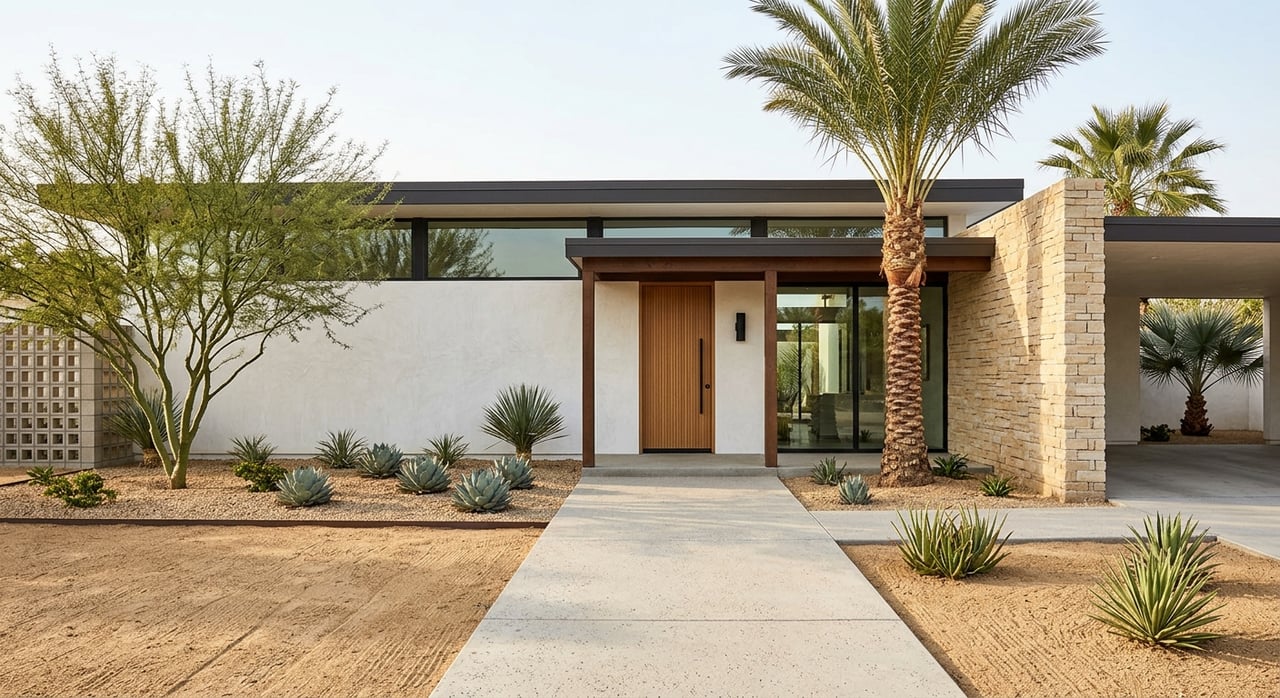
This neighborhood is known for butterfly roofs, folded-plate roofs, Swiss Miss A-frames, post-and-beam construction, and walls of glass. The General Plan describes a grid pattern with cul-de-sacs, open front yards, and a policy direction that encourages preservation and discourages tear-downs.
If your top priority is a distinct and highly recognizable midcentury identity, Vista Las Palmas may be the most direct match. It is less about broad architectural variety and more about a very specific design language that draws buyers who know exactly what they want.
As of April 30, 2026, the city listed 68 registered vacation rentals out of 397 residential units here, or 17.38 percent. Among the four neighborhoods in this guide, that is the highest share, which may be useful if you are trying to understand how visitor-oriented an area could feel.
The Movie Colony offers one of the strongest combinations of central location and established character. The city places it between Avenida Caballeros, Indian Canyon Drive, Tachevah Drive, and Alejo Road.
The General Plan describes an eclectic mix of older historic homes on larger, highly landscaped, usually walled lots. It also notes no curbs and trees and plantings in the right-of-way, which helps create a softer, more mature streetscape.
Because it sits close to Uptown and Downtown services, The Movie Colony often appeals to buyers who want both privacy and convenience. If you want an established neighborhood that still feels connected to the city’s central retail and service core, this area deserves a close look.
As of April 30, 2026, the city listed 33 registered vacation rentals out of 226 residential units, or 14.60 percent. That places it between Old Las Palmas and Vista Las Palmas in short-term rental exposure.
Andreas Hills offers a different Palm Springs experience. Rather than centering on walkability to Downtown, it aligns more closely with privacy, views, and the feel of custom homes shaped by the land.
Palm Springs treats hillside areas as a special design category. In areas with slopes of 10 percent or greater, the city applies special design review, expects homes to fit natural contours, encourages preservation of natural vegetation where possible, and seeks to protect view corridors and viewsheds.
That planning framework helps explain why Andreas Hills often attracts buyers looking for a more secluded setting. As of April 30, 2026, the city listed 20 registered vacation rentals out of 512 residential units, or 3.91 percent, the lowest share among the four neighborhoods covered here.
If you are deciding between these neighborhoods, it helps to match your search to your highest priority instead of trying to solve for everything at once.
These are not official rankings. They are a practical synthesis of the city’s design guidance, neighborhood descriptions, and current vacation-rental density data.
One of the most important Palm Springs buyer questions is whether a neighborhood identity sits on top of another layer of governance. ONE-PS neighborhood organizations are not private HOAs, so you should confirm what actually governs the specific property you are considering.
That may include a condo association, a private HOA, or historic review requirements. The city’s historic district information shows why this can get more layered than buyers expect, especially where ownership-association rules and historic-design constraints may overlap.
If you are comparing older and architecturally sensitive neighborhoods such as Old Las Palmas, Vista Las Palmas, or The Movie Colony, this step is especially important. Renovation freedom can vary significantly from one property to the next.
Vacation-rental data should not be treated as a full measure of neighborhood quality or owner occupancy. Still, it can be a useful lifestyle clue when you are trying to understand how visitor-oriented a neighborhood may feel.
As of April 30, 2026, the city’s registered vacation-rental shares for these four neighborhoods were:
| Neighborhood | Registered vacation rentals | Residential units | Share |
|---|---|---|---|
| Vista Las Palmas | 68 | 397 | 17.38% |
| The Movie Colony | 33 | 226 | 14.60% |
| Old Las Palmas | 43 | 447 | 9.62% |
| Andreas Hills | 20 | 512 | 3.91% |
This is not a substitute for walking the block, visiting at different times, and evaluating the home itself. But it can help you ask better questions about the day-to-day environment you want.
Before you write an offer, it helps to screen both the neighborhood and the property with a short, focused checklist.
The right neighborhood in Palm Springs is rarely just the one with the best photos. It is the one that aligns with how you want to live, what kind of design speaks to you, and how much flexibility you want as an owner.
If you want help comparing Palm Springs neighborhoods through the lens of architecture, lifestyle, and long-term fit, Kyle Gilligan can help you narrow the options and find the right match.
Stay up to date on the latest real estate trends.
We pride ourselves in providing personalized solutions that bring our clients closer to their dream properties and enhance their long-term wealth.